Friday, August 30, 2013

Kernow Cowl (And A Yarn Story)

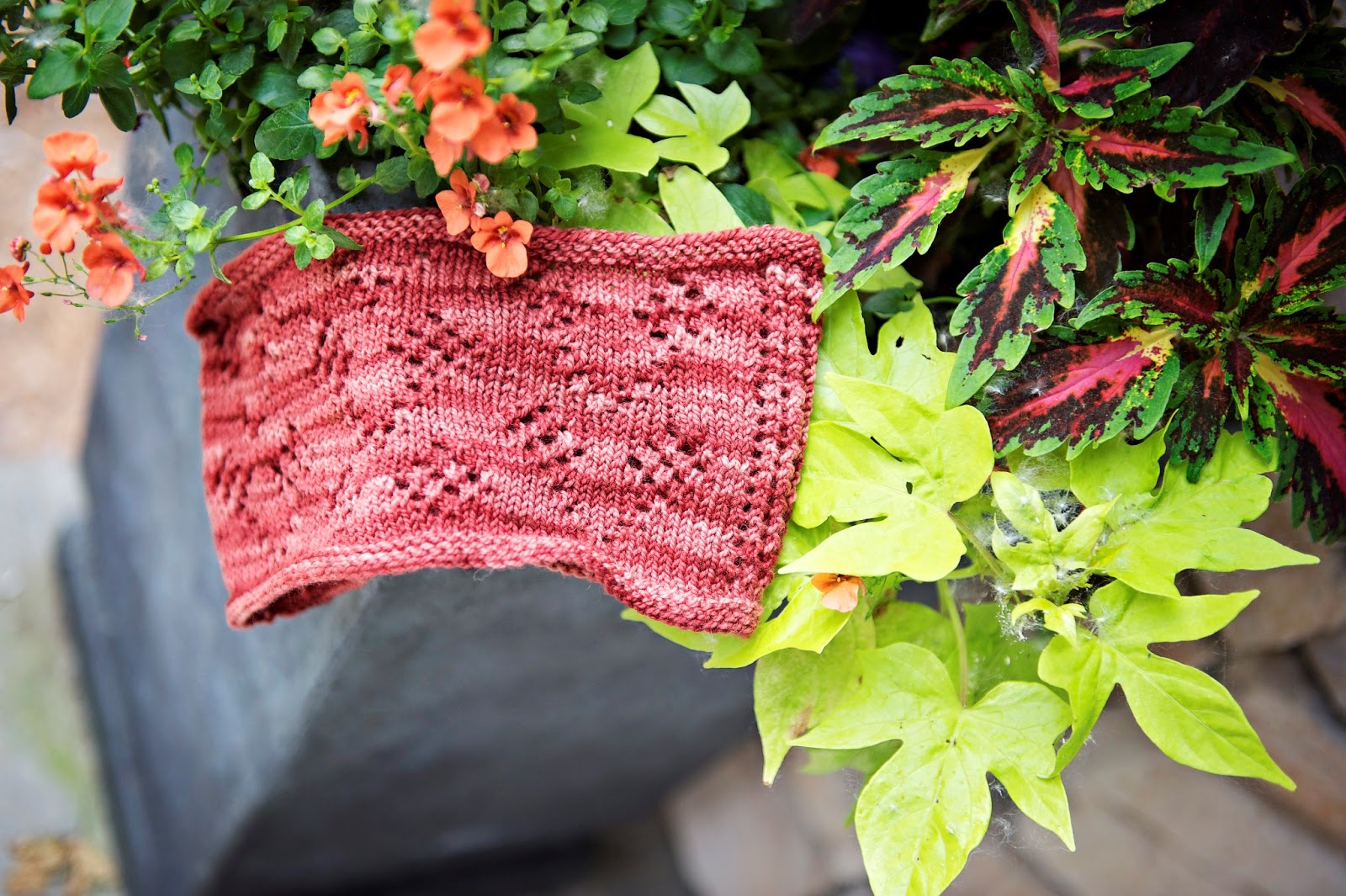
I've just released a new pattern.  Introducing...the Kernow Cowl.


Worked in two colors with a simple slipped stitch pattern and a light worsted weight yarn, the cowl works up quickly.  And with only one color used in a row, it's easy for the colorwork-shy. 


As designed, Kernow has a circumference of about 26 inches -- not too tight around your neck, but still cozy and warm, and perfect for tucking under a jacket or oversized sweater.


But it would be a simple matter to add a few repeats and turn the cowl into an infinity scarf. 
 

The yarn I chose for this project is Pioneer, a 100% Organic Merino naturally dyed by A Verb for Keeping Warm.  It's soft and spongy-squishy and was a joy to knit with, but what I love as much as the yarn itself is the yarn's story.  For this is no ordinary mass-produced merino.  Pioneer is the first in a line of yarns produced by Verb as part of their California Wool Project.  The sheep who provided the wool that went into Pioneer were raised by none other than Sally Fox, perhaps best known for her work with naturally colored cottons.  The full story of Pioneer and the California Wool Project can be found here


Kernow Cowl is available on Ravelry.  I hope you like it.


Friday, August 16, 2013

Tortoise on the Loose!

I was working in my studio yesterday, just doing my thing, when John rushed by the open window, carrying a large plastic bag and clearly on a mission.

John:  Hey hon, I'm on my way to feed the tortoise that's up on our hill some watermelon rinds.  Wanna come?

Me:  Yeah, sure.

Me:

Me: 

Me:  Um, tortoise?

And lo, there was indeed a tortoise up on the hill.  A big one.

 
While I was snapping pictures and marveling at the not-so-wild wildlife, John went to grab the neighborhood phone directory and track down the owner of the tortoise.  A few calls did it, and we learned that he belongs to a neighbor a few houses down the road.
 
This is Herman.  He's 10 years old.  Apparently Herman's an escape artist and gets out at least once a year and goes on a walk-about.  He can cover some ground; our house is at least a quarter mile from where he lives.  And Herman can sure move quickly.  By the time our neighbor's son had come to collect him -- less than 10 minutes or so -- Herman had made his way down the hill, up our driveway, and along the side of the house to hide behind the a/c unit.

 
The watermelon was a hit.

Powerful forelegs, with thick scaly skin.

Strrrrrretch.
 

The shell is amazing.  From above, it's like looking down at the mesas in the desert southwest.
 

First a llama, then a tortoise.  Can't imagine what's next.  If it's a cow, I may just keep it.

Thursday, August 8, 2013

CSA, Samurai Style

Almost two years here in our new humble abode, and I've yet to go to a local farmers' market.  I know, right?  But surprisingly, the markets around here only run from June through the end of October.  We moved in right as the local markets were closing for the season, and then the following summer I was travelling and working constantly for shows, and well.  Trips to the farmers' markets just haven't happened.

So I was thrilled when I learned of a new farm in town that was running a Community Supported Agriculture (CSA) program.  If you're unfamiliar with CSA's, they are a partnership between the farmer and subscribers.  You pay a membership fee up front, essentially buying a share of the farms' produce for the upcoming season.  Each week, members pick up a box of freshly-picked produce at the farm.  What you get is whatever is fresh that week, and the contents of the boxes change as the season progresses.

South Fork Farm has a really interesting history.  Owners Jackie and Ryan have leased 10 acres of farmland from the American River Conservancy.  The farm, part of 272 acres of beautiful land being protected by the Conservancy, is located near the south fork of the American River (hence the name) and is very close to where gold was first discovered in California.  A vineyard operated here in the 1850s-1860s, and then in 1869 the site became the home of the first Japanese settlement in North America, when a group of 22 Samurai and their families arrived and established the Wakamatsu Tea and Silk Colony.  Unfortunately, the colony was not successful and the people dispersed, all but two who stayed on when the Veerkamp family bought the land and established a farm and dairy.  Luckily the Veerkamps helped preserve the history of Wakamatsu (now on the National Register of Historic Places), and the Conservancy (who purchased the land from the Veerkamps in 2010) now works with a number of organizations to keep that history alive. 

 One of the farm's fields prepped for planting at the beginning of the season.
 
Seedlings in the hot house.
 
It's a win-win.  Land is being conserved, history is being preserved, young farmers have an opportunity to farm without the debt associated with high land purchase costs, and the community has access to certified organic and locally grown produce.  In addition to vegetables, South Fork Farm has planted two acres of heirloom wheat and plans to expand production in coming years.  The owners have purchased a combine and a grain mill, built a wood-fired oven, and now also sell bread made with their own wheat and baked right there at the farm in their wood-burning oven (it's delicious).  Their goal is to eventually grow enough wheat that they can sell also flour at their farmstand.  And oh, am I looking forward to that.


The wood-fired oven, and breads made at the farm.
 
Thursday is produce box pickup day, and I just returned from a trip to the farm to get my box.  It's 20 miles roundtrip to the farm, but I've turned it into a pleasant weekly ritual.  It's a lovely drive, and I pass vineyards, farms, pretty views, and one property with at least 30 ponies milling about.  Ponies!!!

I've been trying to eat better and cook healthier meals on a regular basis, and getting a big box of fresh produce each week is a good way to encourage that, as well as being a great way of developing cooking skills.  I'm becoming much more adept at pulling this and that out of the fridge and coming up with a spur-of-the-moment recipe.

The farmstand building.

The farm's old Ford tractor.
 
So, what was in this week's box, you ask?  Well, a lot.  Arugula, garlic, chives, thyme, fennel, red onions, 3 kinds of eggplant, 2 varieties of sweet peppers, summer squash, tomatoes, two types of cucumbers, and watermelon, and French chanterelle melons. 

And what will I do with all of this, you ask?  Well, the fennel bulb will be sliced and topped with some thinly sliced red onion, some of the chopped fennel fronds, oranges, and a citrus vinaigrette for a nice summer salad.  Some of the eggplant will be grilled, then preserved with thyme and sliced garlic in olive oil and stored in the fridge to use later for sandwiches or to put in pasta.  The rest of the eggplant will likely be turned into ratatouille.  There will be cucumbers topped with feta cheese and splashed with lemon and olive oil, and something will be probably be sautéed and mixed with pasta and maybe tossed with pesto.


Veggies for sale at the farm's open house this past April:  carrots, radishes, spring onions.

This is the Farm's first year of operation, and it will be interesting to see how it grows and changes with time and experience.  If you have a CSA near you, I'd encourage giving it a try.  It's a big commitment, but I'm finding it to be worth it.

Saturday, June 29, 2013

Formation pattern release

There are several flocks of Canada Geese that have taken up permanent residence by the ponds near my home in Northern California.  Every so often they do a fly-over, honking loudly as they go by.  That familiar V formation is a sight to see, and it inspired this pretty infinity scarf and cowl.


The infinity scarf is worked in A Verb for Keeping Warm's Floating, a lusciously soft blend of superfine alpaca, silk, and cashmere.  Wear the scarf long -- the yarn has wonderful drape -- or wrap it a couple of times around your neck to help keep you toasty warm.


The cowl is worked in another Verb yarn, Creating, which is soft and squishy and has lovely stitch definition.  The cowl hugs your neck and is perfect for when you want a little something to tuck under a sweater or jacket.


The infinity scarf is worked back-and-forth widthwise, starting with a provisional cast on and grafting the ends to finish (and of course you can always use a 3-needle bind off if Kitchener stitch makes you want to run screaming from the room).  This construction makes it easy to knit a standard long scarf should you prefer.  For another look, choose a bulky yarn, work the pattern repeat twice across and shorten the length before grafting the ends together, and you have a nice big cowl. 

 
The cowl is knit in the round and is a snap to finish -- perfect for almost-instant gratification and spur-of-the-moment gift giving. 


Thanks as always to Knitterella Jill, the lovely model and graphic designer who put the pattern into presentable form.

Formation is now available for purchase here.   


Wednesday, June 5, 2013

TNNA, Sans Booth

TNNA's Summer Trade Show is just two weeks away!  I'm excited to be going, yet for the first time since I started exhibiting at the show seven years ago, I won't be having a booth.

This time, I'll be taking a professional design class, helping out in the Elemental Affects booth, and walking the show floor.  You know, YARN SHOPPING. 

Being normally tied to a booth during the entirety of a show's open hours means that I rarely get the opportunity to wander around.  This time, I'll get to see all of the wonderful products on display, and better yet, be able to meet and talk to many of the vendors.  I'm really looking forward to that.

I hope to see you there! 

Saturday, May 25, 2013

Llama on the Loose!

I was heading out to the grocery store/post office this morning when movement at the edge of our property caught my eye.  Glancing up, I spied a ..... llama.


This might not normally be of any interest, except that I don't have a llama.  Nor does any of the neighbors.  So of course I got out of my car to get a closer look.

 
Next to our house is some undeveloped, most wooded land.  We'd heard that a llama had been spotted in there, and John had actually seen it in this same area a couple of days ago.  It doesn't run away, but hasn't let anyone get too too close.
 
 
The neighbor across the street from us had left out some water for the animal, and I saw the llama poking at the now-empty bucket.  So I ran to re-fill it.

Here llama llama!

She sure knew what a bucket was, and came for a closer look.

Hmmm, whatcha got there?

Okay, I'll come closer.

Water's great, but I was expecting a little treat, maybe?
 
Yeah fine, enough of you.

She had a sip of water and then trotted back off off into the woods, so I went on to do my errands.  Later I did a quick internet search and learned that llamas eat mostly grass hay, so she should be fine where she is for a bit.  Looks like we'll need to contact Animal Control to see if anyone has reported a lost llama. 

Thursday, May 2, 2013

A Few of My Favorite Things: Garden

The weather is turning nice finally -- at least around these parts.  No snow in the forecast, hallelujah.  I've got thoughts of sunshine and tomatoes and flowers and cranberry gin dancing through my head and have been trying to get outdoors and in the garden as much as possible.  With that in mind, I thought I'd list a few of my favorite things for the garden.


Plant Protectors.  I call these gizmo's water walls.  They are made of heavy semi-opaque plastic and formed so that there are "cells" that can be filled with water.  The water absorbs heat from the sun during the day, protecting young plants overnight from the cold, and the plastic provides wind protection as well.  I tried these for the first time this year and was amazed at how well they worked.  My tiny tomato plants were flowering and almost bursting out the top by the time I removed the forms.  They can be reused repeatedly, another bonus.  I bought a package of 3 for about $14 at my local plant nursery. 
 
 
Tomato Cages.  Speaking of tomatoes, these brightly colored tomato cages are a whole lot more fun than the standard galvanized ones. 
 
 
Snips.  These little cutters made by Fiskars are perfect for snipping herbs or deadheading small plants.
 
 
Garden Attire.  A wide-brimmed hat is a necessity when working outdoors.  This one from Angela's Garden is made of cotton and can be thrown in the wash.  The matching garden apron has pockets in the front for holding all manner of things, including little snips.  The benefit of having a convenient place to stash your tools as you mosey around the garden is that you don't forget where you left them, and you don't stick them in your back jeans pocket.  And then try to sit down.  I got my set from Amazon.com, and there lots of styles and prints available.
 
 
Shoes.  Garden attire extends to your feet, and how can you resist fun rubber shoes?  These are by Sloggers, are inexpensive and surprisingly comfortable.  Besides protecting your feet from garden detritus, they are waterproof, so you don't have to worry about getting your socks wet when you play with use the hose. 
 
 
Gloves.  Hand protection is another garden necessity.  I have several types I use, from plain cotton to heavy leather, depending on the task.  But I really like these brightly colored nitrile-coated gloves.  They're great for digging in the dirt, and the waterproof palms keep your fingers from getting all yucky and pruney when you play with use the hose.  I found a package of 6 for about $8 at Costco.
 
 
Red Wheelbarrow.  Enough said.
 
 
Garden Art.  I love quirky little garden pieces, and the work by Dan Shattuck is among my favorite.  He puts together recycled kitchen utensils in the most creative ways.  This dragonfly is made with knives, fork heads, and the handle of a spoon.  It's utterly charming.  Unfortunately Dan doesn't seem to have a website, but he does art-in-the-park type shows throughout California's Central Coast. 
 
What are your favorite garden things?